
eBook, Operational AI
How WaveAgent Works: Inside the Architecture for Governed Enterprise AI Execution
Dan Mitchell
SVP Platform Strategy
Most AI tools can tell you what to do. WaveAgent is built for the part where someone actually has to do it.
This guide is a technical deep dive into how WaveAgent works, covering its architecture, workflow coordination model, governance and security controls, integration approach, and deployment strategy for enterprise AI execution.
Key Takeaways
1
WaveAgent centralizes operational AI into one environment where users review insights, approve actions, and coordinate execution instead of working across disconnected applications.
2
Moving from AI-generated recommendations to real operational execution requires validation, permissions, approval routing, rollback handling, and recovery, not just a better answer.
3
Governance is built into WaveAgent's architecture from the start, with RBAC, policy enforcement, environment separation, and operational traceability as core capabilities.
4
WaveAgent is model-agnostic, so organizations can adopt new AI models as they emerge without rebuilding their operational infrastructure.
5
WaveAgent integrates with existing enterprise systems and data platforms, and can pair with the ONE Platform for organizations that need a governed AI-native master data foundation.
Executive Summary
Enterprise AI is entering a new phase. Most organizations are no longer asking whether AI can generate content, summarize information, or answer questions. They are now asking how AI can safely coordinate operational workflows, approvals, decisions, and execution across real enterprise systems.
That shift changes the technical challenge entirely. Across industries, technology and innovation teams are rapidly building AI-driven applications, copilots, workflow assistants, and internal automation tools. Many of these initiatives demonstrate real promise during early experimentation.
But moving from successful prototypes into reliable enterprise deployment introduces a very different level of complexity. Security reviews expand. Governance requirements increase. Workflow coordination becomes harder. Operational risk grows quickly once AI begins interacting with real business systems and operational processes.
Most enterprises do not need another disconnected AI interface layered across existing applications. They need a centralized operational environment where users can interact with insights, recommendations, approvals, workflows, and execution processes in one place.
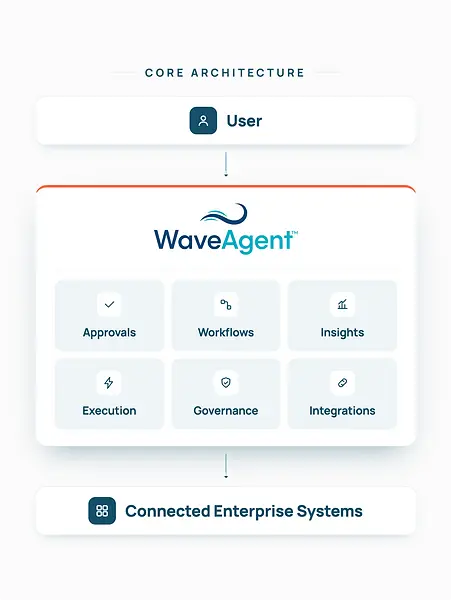
That is the challenge Digital Wave Technology’s® WaveAgent was designed to solve. WaveAgent serves as the centralized operational AI environment where users work directly with intelligence, workflows, approvals, recommendations, and execution processes while connected enterprise systems remain integrated behind the scenes.
Rather than requiring teams to navigate across disconnected enterprise applications, WaveAgent coordinates operational execution across systems through governed workflows, controlled integrations, and policy-driven execution management.
This allows organizations to modernize operations, accelerate decision-making, reduce workflow fragmentation, and execute actions across enterprise systems without requiring large-scale rip-and-replace initiatives. Organizations can deploy WaveAgent using existing enterprise data platforms, operational systems, and governance environments, or pair it with the ONE® Platform for a fully governed AI-native master data foundation.
This guide provides a technical deep dive into:
WaveAgent architecture
enterprise workflow coordination
governance and security controls
integration strategy
operational execution
scalability and performance
deployment architecture
enterprise AI reliability
It is designed for CIOs, CTOs, enterprise architects, AI leaders, platform engineering teams, innovation leaders, and technical decision-makers evaluating how to deploy enterprise AI safely and effectively at scale.
The Enterprise AI Deployment Challenge
Most AI tools today focus on prompts, interfaces, assistants, recommendations, and content generation. Enterprise operations require more than that. Once AI starts interacting with operational systems, organizations have to manage workflow coordination, approvals, permissions, rollback controls, operational traceability, governance policies, system interaction, execution reliability, and deployment oversight.
Generating an answer is relatively easy. Coordinating safe, reliable operational execution across enterprise systems is significantly harder. That distinction is shaping how enterprise AI gets architected going forward. Most enterprises don't need another disconnected AI interface layered on top of what they already have. They need a centralized operational environment where people can work with insights, recommendations, approvals, workflows, and execution in one place. That's the problem WaveAgent was built to solve.
WaveAgent: A Centralized Operational AI Environment
WaveAgent centralizes operational AI coordination into a single enterprise environment. Inside WaveAgent, users review operational insights, receive AI-driven recommendations, manage workflows, approve actions, coordinate execution, monitor operational activity, and trigger downstream updates across enterprise systems.
Instead of moving between disconnected applications, users get one operational experience across workflows, systems, approvals, and AI-driven execution. Connected enterprise systems stay integrated behind the scenes while WaveAgent handles workflow management and execution centrally. This cuts down on operational fragmentation, workflow delays, disconnected approvals, manual coordination overhead, and execution inconsistency. The result is a more coordinated, more scalable operational environment for enterprise AI.
Flexible Enterprise Deployment Architecture
WaveAgent operates flexibly across modern enterprise environments. Organizations can deploy it using existing enterprise systems, cloud data platforms, operational applications, APIs, warehouses, and governance environments while centralizing AI-driven workflows and execution inside WaveAgent.
For organizations with governed data environments such as Snowflake, ClickHouse, ERP systems, APIs, or enterprise applications, WaveAgent integrates directly through governed integrations and controlled workflow execution. For organizations that need a governed AI-native master data foundation, WaveAgent can also operate alongside the ONE Platform, which serves as the system of record for governed master data and AI-ready operational information.
This modular deployment model lets organizations preserve existing investments, modernize incrementally, reduce deployment risk, accelerate time to value, and avoid large-scale replacement initiatives.
How Users Work Inside WaveAgent
WaveAgent is the operational AI workspace where users interact with workflows, intelligence, approvals, and execution in one place. Instead of logging into multiple disconnected systems throughout the day, users operate inside WaveAgent while connected enterprise systems remain integrated behind the scenes.
Inside WaveAgent, users review operational insights, analyze AI-generated recommendations, approve or reject actions, coordinate workflows, manage operational exceptions, monitor execution activity, oversee workflow progression, and trigger downstream operational updates. Once an action is reviewed and approved, WaveAgent coordinates execution across connected enterprise systems through governed integrations and policy-controlled workflows.
Enterprise Workflow Coordination and Execution
Enterprise AI requires more than recommendations. It requires coordinated operational execution. General-purpose AI systems are probabilistic. Enterprise operations require reliability, oversight, and predictable system behavior. Moving from AI-generated recommendations to real operational execution introduces a different level of complexity. Workflows require approvals, rollback controls, permissions, operational safeguards, and coordinated system interaction before actions can safely execute across the business.
A recommendation engine can suggest an action. An enterprise operational AI environment has to validate actions, apply governance policies, verify permissions, route approvals, coordinate workflows, manage rollback handling, capture operational traceability, recover from failure states, and coordinate downstream system updates. That's the gap between an AI generating an answer and an AI safely coordinating enterprise execution. WaveAgent handles this through workflow state management, execution queues, approval routing, retry handling, rollback registration, operational monitoring, recovery coordination, parallel workflow execution, and policy-controlled system interaction.
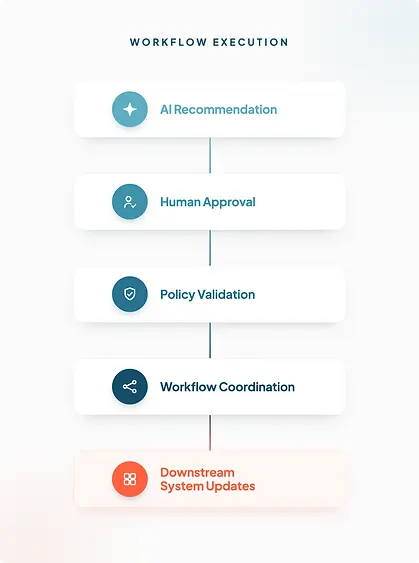
Generating an answer is relatively easy. Coordinating safe and reliable operational execution across enterprise systems is significantly more difficult.
Governance and Security Architecture
Enterprise AI deployment requires governance by design.
WaveAgent was architected to operate within enterprise security, compliance, and operational control environments from the beginning.
Capability | Purpose |
RBAC and role-scoped permissions | Controls workflow and operational access |
Policy enforcement | Applies governance controls before execution |
Operational traceability | Maintains workflow visibility and audit history |
Human approval workflows | Supports operational oversight |
Environment separation | Supports Dev/Test/Prod governance |
Tenant isolation | Maintains organizational boundaries |
Rollback controls | Supports operational recovery |
Prompt injection defense | Protects workflow execution integrity |
Operational monitoring | Tracks execution behavior and system activity |
These controls help organizations reduce operational risk, maintain governance oversight, support compliance requirements, preserve enterprise safeguards, improve deployment confidence, and scale operational AI safely.
Enterprise Security Model
WaveAgent was designed to align with enterprise security expectations rather than operate outside them. Key architectural principles include least-privilege access, workflow-level entitlements, environment isolation, controlled execution boundaries, secure credential management, policy validation before execution, operational traceability, and governed deployment controls. This lets organizations maintain security oversight while expanding enterprise AI capabilities across operational workflows.
Integration Architecture
WaveAgent coordinates across modern enterprise environments through flexible, governed integration patterns. Supported approaches include APIs and service-based integrations, event-driven architectures and workflow triggers, enterprise identity and access systems, operational and transactional platforms, structured and unstructured data environments, cloud and hybrid infrastructure, business applications and workflow systems, enterprise data platforms and repositories, workflow automation and approval systems, and cross-system operational coordination.
This integration-first architecture lets organizations preserve existing technology investments, reduce deployment friction, accelerate implementation timelines, avoid large-scale replacement initiatives, and support phased deployment strategies.
Scalability and Performance
Enterprise operational AI systems need to support scale, reliability, and execution consistency. WaveAgent was built with scalability and operational resilience as core architectural principles, supporting distributed workflow coordination, asynchronous execution handling, workload isolation, parallel workflow execution, execution queue management, retry and recovery handling, multi-tenant scalability, operational telemetry, and fault tolerance strategies. Organizations can scale operational AI workflows without compromising reliability.
Model-Agnostic Architecture
The enterprise AI ecosystem is evolving fast, and organizations want flexibility across model providers, deployment strategies, infrastructure environments, AI cost structures, and governance requirements. WaveAgent is model agnostic by architecture, so organizations can adopt new AI models as they emerge without rebuilding operational infrastructure. This reduces vendor lock-in risk, migration complexity, architectural dependency, and future platform constraints, and lets organizations adapt as enterprise AI capabilities continue to evolve.
Operational System of Record for Workflow Execution
WaveAgent serves as the centralized operational environment for workflow coordination, approvals, execution management, and operational AI activity. The platform maintains operational visibility, workflow state management, execution coordination, approvals, rollback handling, and operational traceability across enterprise workflows. Connected enterprise systems and governed data environments stay integrated through controlled execution and policy-driven system interaction. When paired with the ONE Platform, organizations get a fully governed AI-native master data foundation alongside centralized operational AI coordination and execution, without needing to replace existing enterprise environments.
Incremental Enterprise Deployment
Most enterprises don't want large-scale AI transformation initiatives that disrupt operations. WaveAgent supports phased deployment and incremental modernization. Organizations can start with targeted workflows, expand gradually, preserve existing systems, centralize operational coordination incrementally, integrate across existing environments, and demonstrate measurable business impact before broader expansion. This reduces deployment friction, operational disruption, implementation risk, and time-to-value concerns, and lets organizations scale operational AI capabilities at a pace that matches operational readiness.
What Makes Enterprise AI Different
Enterprise AI is fundamentally different from consumer AI experiences or isolated automation tools. Enterprise deployment requires:
operational coordination
workflow reliability
governance controls
policy-driven execution
rollback handling
operational traceability
system integration
security oversight
execution consistency
production readiness
Most AI platforms focus primarily on prompts, interfaces, or recommendations. Enterprise organizations require centralized operational coordination across workflows, systems, approvals, and execution processes. That is the architectural challenge WaveAgent was designed to address.

Most enterprises do not need another disconnected AI interface layered across existing applications. They need a centralized operational environment where users can work with insights, approvals, workflows, and execution in one place.
Final Thoughts
Enterprise AI is moving past experimentation. Organizations are now evaluating how AI can safely coordinate workflows, approvals, operational decisions, and execution across real enterprise environments. That requires centralized operational coordination, workflow execution management, governance controls, operational reliability, scalable architecture, secure system interaction, and production-ready execution oversight. WaveAgent was built for this phase of enterprise AI deployment. Not as another disconnected AI interface, but as a centralized operational AI environment where users coordinate workflows, approvals, intelligence, and execution across enterprise systems in one place.
Agentic Operation Layer Checklists
Enterprise AI Governance
Capability | Why It Matters |
RBAC (Role Based Access Control) | Ensures users only have access to the workflows, approvals, operational actions, and data appropriate for their role and responsibilities. |
Approval Workflows | Introduces human oversight and controlled decision-making before AI-driven actions execute across enterprise systems. |
Rollback Handling | Allows organizations to recover safely from failed, partial, or unintended operational actions without disrupting business processes. |
Operational Traceability | Maintains visibility into workflow activity, approvals, execution history, and system interactions for governance, auditing, and troubleshooting. |
Environment Controls | Separates development, testing, and production environments to reduce operational risk and support controlled deployment practices. |
Model Abstraction | Allows organizations to adopt evolving AI models and providers without rebuilding operational workflows or enterprise infrastructure. |
Tenant Isolation | Maintains secure separation between organizational environments, workflows, users, and operational data. |
Prompt Injection Defense | Protects workflows and operational execution from manipulated inputs, unsafe instructions, or unintended AI behavior. |
Policy Enforcement | Applies governance, compliance, security, and operational rules before actions execute across enterprise systems. |
The Complementary Ecosystem
Platform Layer | Role in Enterprise AI Architecture | Key Platforms | WaveAgent Relationship |
Intelligence Layer | Reasoning, language understanding, code generation, analysis | OpenAI, Anthropic, Gemini, Llama | WaveAgent consumes as interchangeable reasoning components |
Builder Layer | Rapid UI prototyping, application scaffolding, developer productivity | WaveAgent, Cursor, Claude Code, MCP IDE | Useful for WaveAgent dashboard and approvals UI prototyping |
Data Platform Layer | Analytical processing, data transformation, ML model serving | ONE® Platform, Snowflake, Databricks, ClickHouse | WaveAgent integrates as data source and execution target |
Execution Layer | Governed, policy-controlled, auditable business execution across enterprise systems | WaveAgent | Owns this layer — no credible competition at equivalent TCO for mid-market |
Core Architectural Principles
Architectural Principle | Why It Matters |
Centralized Operational Coordination | Provides a unified operational environment for workflows, approvals, intelligence, and execution across enterprise systems. |
Governance-First Execution | Applies policy controls, permissions, approvals, and operational safeguards before actions execute. |
Integration-First Architecture | Enables WaveAgent to operate across existing enterprise systems, data environments, and operational workflows without requiring rip-and-replace initiatives. |
Workflow State Management | Maintains visibility into workflow progression, approvals, retries, rollback handling, and execution status. |
Controlled System Interaction | Coordinates operational execution across connected enterprise systems through governed integrations and policy-based controls. |
Operational Traceability | Preserves visibility into operational activity, workflow execution history, approvals, and downstream system interaction. |
Model-Agnostic Architecture | Allows organizations to adopt evolving AI models and providers without rebuilding enterprise operational infrastructure. |
Phased Enterprise Deployment | Supports incremental rollout strategies that reduce operational disruption and accelerate time to value. |
Operational Reliability and Recovery | Supports retry handling, rollback coordination, failure recovery, and execution consistency across workflows. |
Scalable Workflow Execution | Enables coordinated operational execution across distributed enterprise environments and growing workflow volumes. |
Enterprise Deployment Considerations
Deployment Consideration | Why It Matters |
Phased Rollout Strategy | Allows organizations to begin with targeted workflows and expand incrementally while reducing operational disruption and deployment risk. |
Integration Strategy | Defines how WaveAgent will coordinate across existing enterprise systems, APIs, data environments, and operational workflows. |
Governance Planning | Establishes approval policies, operational safeguards, permissions, and execution controls before scaling AI-driven workflows. |
Workflow Prioritization | Helps organizations identify high-value operational workflows that can deliver measurable business impact quickly. |
Operational Ownership | Clarifies responsibility for workflow oversight, approvals, monitoring, and operational management across teams. |
Environment Separation | Supports secure Dev, Test, and Production deployment practices while reducing operational and security risk. |
Approval Structures | Determines where human oversight, escalation paths, and decision checkpoints are required within workflows. |
Model Governance | Defines how AI models are evaluated, approved, monitored, and updated across enterprise operational environments. |
Security and Compliance Review | Ensures enterprise AI deployment aligns with organizational security, compliance, privacy, and operational requirements. |
Monitoring and Operational Visibility | Establishes visibility into workflow execution, system interaction, approvals, failures, and operational performance. |
Change Management and Adoption | Helps organizations onboard teams, align operational processes, and support adoption of centralized AI-driven workflows. |
Scalability Planning | Ensures workflows, integrations, operational coordination, and governance models can scale with enterprise growth over time. |
Common Technical Evaluation Questions
Where do users operate?
Users work directly inside WaveAgent while connected enterprise systems remain integrated behind the scenes.
Is WaveAgent tied to one model provider?
No. WaveAgent is model agnostic by architecture.
Does WaveAgent replace our ERP or data platform?
No. WaveAgent integrates across existing enterprise environments while centralizing operational AI coordination and workflow execution.
Can WaveAgent work with Snowflake or ClickHouse?
Yes. WaveAgent is designed to integrate across modern enterprise data environments and operational systems.
Does WaveAgent require a rip-and-replace initiative?
No. The platform supports phased deployment and incremental modernization strategies.
What happens if a workflow fails?
WaveAgent supports rollback handling, retry management, operational monitoring, and recovery coordination.